
Restoring an 1859 Chickering Florida Heirloom Grand Piano
Brigham Larson PianosHow CNC Technology is Rebuilding the “Wild West” of Piano Design
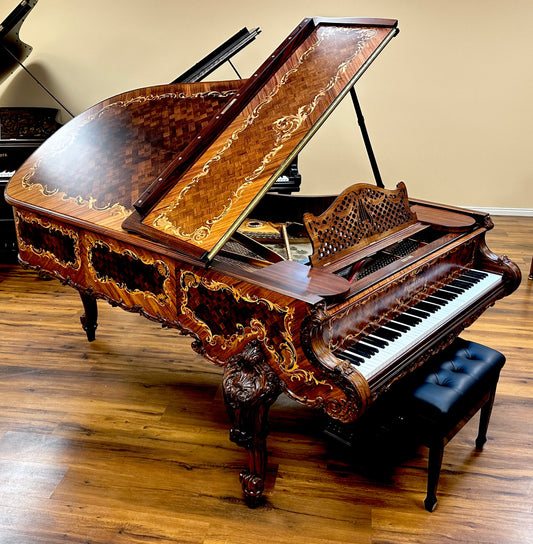
When we take on a restoration like this 1859 Chickering rosewood grand piano, we’re not just rebuilding an instrument—we’re solving a 160-year-old engineering puzzle.
This particular heirloom piano, originally from Florida, represents a time before standardization—when piano makers were still experimenting, improvising, and sometimes… making things incredibly difficult for future restorers.
Today, we’re bringing it back to life using a powerful combination of traditional craftsmanship and cutting-edge CNC technology.
Before Standardization: The “Wild West” of Piano Design
By around 1880, piano manufacturing in the United States became largely standardized.
But in 1859? Anything goes.
Every builder had their own:
- Action geometry
- Component shapes
- Mounting methods
- Mechanical philosophies
And Chickering—innovative as they were—created designs that, while brilliant in their time, are now completely obsolete.
In this piano, we encountered:
- Action parts glued instead of screwed
- Non-standard “whippen-like” components
- Custom brackets with no modern equivalents
- Geometry incompatible with modern replacement parts
The Problem: Obsolete Action Components
The biggest challenge lies in the action assembly, the heart of the piano’s touch and responsiveness.
Originally:
- Components were glued in place (a nightmare for serviceability)
- Parts were inconsistent and fragile
- The design cannot support modern, reliable components
The Solution: Redesigning the Action for Modern Performance
We’ve completely re-engineered key structural components of the action to work with modern flanges and precision-mounted parts.
This includes:
- A newly designed whippen rail
- Custom CNC-machined brackets
- A redesigned hammer rail system
- Precise mounting geometry for modern components
Every piece is carefully engineered to:
- Maintain historical integrity
- Improve long-term reliability
- Deliver a responsive, modern playing experience
CNC Technology: Precision That Was Impossible in 1859
This is where the restoration becomes something truly special.
Using CNC machining, we can manufacture parts that are:
- Ultra-precise (down to thousandths of an inch)
- Perfectly repeatable
- Structurally superior to original components
What CNC allows us to do:
- Digitally design obsolete parts from scratch
- Create complex geometries (including angled flange interfaces)
- Execute multi-stage machining operations with exact consistency
- Produce clean, tight-fitting components that “just work”
For example:
- A 1/8” end mill cuts the base shape
- A 1/16” end mill at 24,000 RPM refines intricate details
- Angled cuts are programmed to perfectly match modern flange geometry
To put that in perspective:
- A typical drill runs ~3,000 RPM
- This CNC machine runs 5–6× faster, with exponentially greater precision


Rebuilding the Structure: Brackets, Rails, and Stability
One of the most critical upgrades in this project is the replacement of original glued brackets with CNC-machined, screw-mounted components.
Why this matters:
Original Design Issues:
- Glued joints weaken over time
- Difficult (or impossible) to service
- Inconsistent alignment
New CNC Solution:
- Precision-cut Baltic birch components
- Clean, countersunk screw mounting
- Perfect alignment with mating rails
- Long-term structural stability
These brackets and rails form the foundation of the action, ensuring everything stays aligned, responsive, and durable.
Materials Matter: Why We Use Baltic Birch
All newly manufactured wooden components are made from premium Baltic birch plywood, chosen for:
- Exceptional dimensional stability
- Resistance to warping and movement
- Superior strength compared to solid wood in this application
It’s a favorite among high-end cabinetmakers—and for good reason.
The Piano Itself: A Beautiful Foundation
While the action is being re-engineered, the entire piano is simultaneously undergoing a comprehensive restoration:
- Rosewood cabinet refinishing
- Cast iron plate restoration
- New string installation
- Soundboard rebuilding
The result is a stunning 19th-century instrument—ready to support a 21st-century action system.
Why This Matters: The Future of Piano Restoration
Projects like this represent the future of high-end piano rebuilding.
We can:
✅ Preserve historic & sentimental family heirloom pianos
✅ Improve performance beyond original design
✅ Ensure serviceability for future generations
✅ Combine artistry with engineering precision
Final Thoughts
This 1859 Chickering isn’t just being restored—it’s being reborn.
By combining:
- Historic craftsmanship
- Modern engineering
- CNC precision manufacturing
…we’re creating something rare:
👉 A true heirloom piano that plays like a modern instrument
👉 A piece of history built to last another 100+ years
Do you have a family heirloom piano in need of restoration? Each year, our shop restores around 100 heirloom upright and grand pianos, helping families preserve the music, memories, and craftsmanship of their treasured pianos. If you’re considering restoring your family heirloom, we’d love to evaluate your piano and provide a free restoration quote.
FREE Heirloom Piano Restoration Evaluation
Learn More About Piano Restoration
Explore How We Use CNC Technology For Piano Restoration
Shop Brigham's Pianos For Sale
Want to learn more? You may also like watching Brigham use the CNC machine to design a missing decorative piece on a piano column ↓